INSIDE RELATIONSHIPS · INSIDE LOVE
Understand how you love.
You can be attracted to someone, feel deeply connected, and still struggle to build a life together. You can have everything you wanted on paper and feel almost nothing in person.
My work helps you understand those differences: what draws you in, what makes you feel close, what you need from a relationship, and whether the person in front of you can actually participate in it.
Words Inform. Actions Demonstrate. Patterns Reveal.
RELATIONSHIP INTELLIGENCE
How do you actually do relationships?
A profile tells me what you like. Your relationship history tells me more. So does how you describe an ex, respond to disappointment, handle uncertainty, ask questions and repair after conflict.
I developed Relationship Intelligence to bring those details into partner selection and relationship development. We examine attraction, connection, behavior, the structure of your life, compatibility and readiness.
Attraction
What gets your attention—and what do you tend to overvalue?
Connection
What makes closeness feel meaningful to you?
Behavior
How do you communicate, disagree, respond to distance and repair?
Structure
What would a relationship need to fit into? Your children, work, routines, independence, family and future all matter.
Compatibility
Can your needs and daily lives work together? Which differences are useful, and which require a conversation?
Readiness
Do you have the emotional and practical capacity for the relationship you say you want? Does the other person?
The work includes assessment, interviews, a personalized profile, a Compatibility Blueprint, date preparation and reflection as a relationship develops. It is a nonclinical framework for understanding relationship patterns and decisions.
Feeling close tells you something. It does not tell you everything.
INTIMACY TYPES
What makes you feel connected?
A long conversation. Being emotionally understood. A hand reaching for yours. Building toward a shared future. Doing something together that becomes a memory.
Those experiences can all create intimacy. Their importance differs from person to person.
I created Intimacy Types to examine five behavioral pathways to closeness:
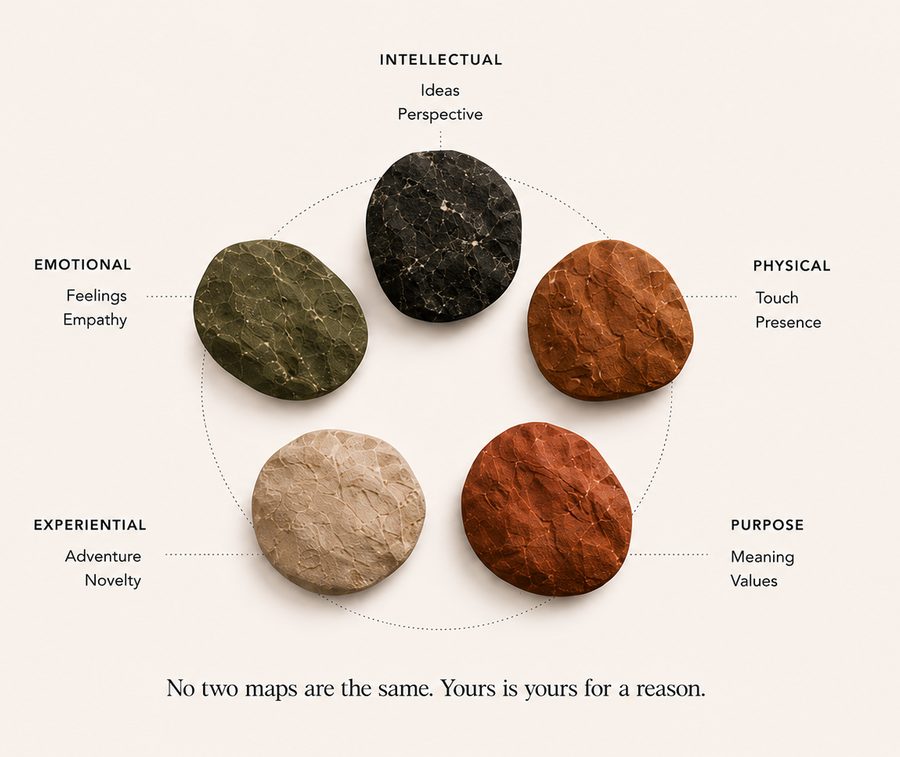
Intellectual
Know my mind.
Be curious about how I think. Let the conversation go somewhere.
Emotional
Know my emotional world.
Listen, respond, let me be honest, and be honest with me.
Physical
Be close to me.
Touch, affection, presence and desire help me feel connected.
Purpose
Build something with me.
Shared direction, contribution and a meaningful future make us feel like a team.
Experiential
Do life with me.
Participate, explore, play and create memories with me.
You may have a primary and secondary pathway, with others becoming more important in different circumstances. Your type gives you language for how you connect, what you miss when connection disappears, and how you try to restore it.
It also raises a question I bring into my exploitation work: what happens when someone learns exactly what makes you feel close—and starts controlling your access to it?
Words Inform. Actions Demonstrate. Patterns Reveal.
E3 MATCHMAKING
Director of Relationship Intelligence
As Director of Relationship Intelligence at E3 Matchmaking, I help clients understand themselves and their relationship patterns alongside the matchmaking process. My work includes a Relationship Intelligence Assessment, Intimacy Typing, a Compatibility Blueprint, relationship readiness, date preparation, post-date reflection, and communication strategy.
“I made her feel safe” is an interpretation.
What did she say? What did she do? Was she curious about you? Did she initiate? What do you still need to learn?
Those distinctions matter. They help separate the connection you experienced from the assumptions you made about the other person.
A list of preferences cannot tell you how two people will handle disappointment, create intimacy, or make room for each other. Relationship Intelligence examines what people bring into dating and what becomes visible as a connection develops.
PRIORIDATING
Date by your priorities.
What do you need a relationship to support? What matters enough that attraction should not talk you out of it?
I created PrioriDating to help people identify those priorities before choosing a partner. A list of desirable traits can tell you who sounds appealing. Your priorities tell you what a relationship needs to make possible in your life.
PROFESSIONAL EXPERIENCE
eharmony and professional experience
As an eharmony Relationship Expert for six years, I contribute to relationship research and public education by identifying dating and relationship trends, helping shape consumer-study topics, interpreting findings, and translating them into practical guidance. I remain active in that role.
My work combines more than 15 years of professional experience in relationship coaching and behavioral dynamics, graduate-level studies in Domestic Violence Intervention and Victim Advocacy at Arizona State University, and specialized professional training through The Gottman Institute in partner aggression and abuse.
BOOKS
Screwing the Rules: The No-Games Guide to Love
Writing has been part of how I examine what people do, what they need, and how they make changes in their lives. I am a five-time published author. My relationship work includes Screwing the Rules: The No-Games Guide to Love.
PRIVATE COACHING
Bring me the actual situation.
The person you keep choosing. The conversation you keep avoiding. The relationship that looks good but feels wrong. Or the connection you want to build with more intention.
We will examine what you want, what is happening, and what you can do next.
You know you want a relationship. Do you know what that relationship needs to look like?
How do you want to spend an ordinary Sunday? What do you need when you are overwhelmed? How much independence feels good? What does a disagreement sound like when both people still respect each other?
We get specific. Then we look at how your choices, communication and current relationships support—or complicate—that picture. We can work on dating priorities, intimacy needs, attraction patterns, compatibility, readiness, communication, boundaries and relationship decisions.
My Relationship Intelligence and Intimacy Types frameworks inform the work. Your actual life determines the questions.
Private coaching is educational and does not provide psychotherapy, diagnosis or clinical treatment.
CONTACT LAUREL
Tell me what you are reaching out about.
Speaking, interviews, private coaching, E3 Matchmaking, or a potential story or guest: send a short introduction and the relevant details.
For events and interviews, include the audience, format and timing. For stories, begin with a short overview. Please leave sensitive personal information out of your first message.