#iTrusted
Romance Fraud Victim Response & Relationship-Based Exploitation
Trusting someone should not become the thing you have to defend after they deceive you.
Laurel House · Relationships and Romance Scams Expert · Behavioral Dynamics Researcher
Someone can be shown evidence of fraud and still believe the relationship is real. A family can recognize the deception and struggle to reach the person experiencing it. A professional can document a financial loss while still needing to understand the relationship that made it possible.
#iTrusted is my developing training and consultation initiative focused on those challenges. It brings relationship expertise, lived experience, research, and professional education to how people experiencing romance fraud are recognized, approached, interviewed, and supported.
The human being inside the crime
“Why did you send the money?” can leave out what came before it: the attention, shared routines, personal disclosures, explanations, promises, and requests that made the transfer seem reasonable at the time.
“What did they promise you?” asks about the relationship. “What happened when you questioned them?” asks about behavior. “What did you know then?” makes room for information that arrived later.
#iTrusted centers those questions. It examines how trust was established, what it allowed someone to access, and how professionals and families can respond without turning disclosure into a defense of the victim’s judgment.
Words Inform. Actions Demonstrate. Patterns Reveal.
THREE AREAS OF WORK
Training, consultation, and education
Case-based education for teams encountering romance fraud and relationship-based exploitation. Training examines the sequence of trust-building, emotional investment, requests, pressure, disclosure, and attempted intervention.
Topics can include
- How someone becomes credible before a financial request arrives.
- Why early contradictions may be interpreted differently as information accumulates.
- How intimacy, future promises, obligation, and fear can influence decisions.
- Continued contact after evidence of fraud has been presented.
- Shame, partial disclosure, and barriers to asking for help.
- Questions that examine the relationship without imposing hindsight.
- How to communicate with attention to autonomy, family involvement, and appropriate support.
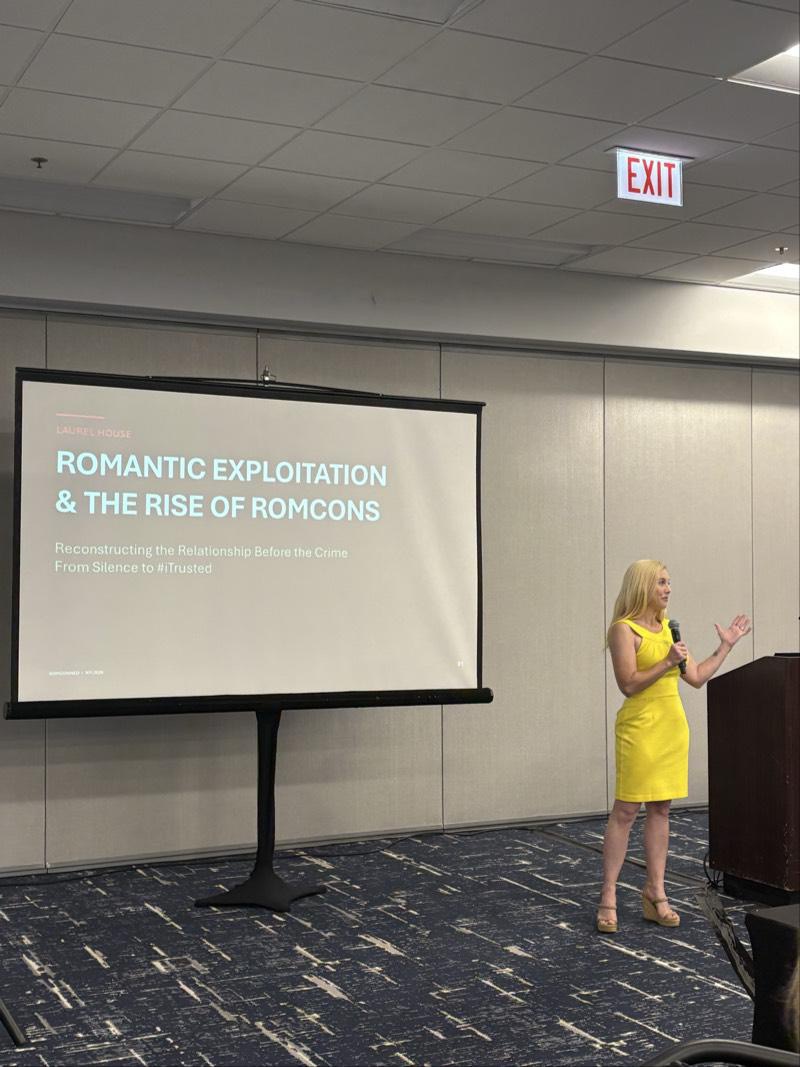
The teaching approach builds on my 2026 National Training Institute presentation. Participants consider a case in stages, using the information available at the time rather than starting with its ending.
2
Case consultation
Examine the relationship context and the barriers to engagement.
Professional teams may need help understanding a complicated relationship timeline, continued emotional investment, or communication that has become adversarial. Case consultation inquiries focus on those relational and behavioral questions.
A defined engagement may include
- Reviewing a relationship chronology and relevant communication patterns.
- Identifying reported promises, requests, pressures, and responses to boundaries.
- Distinguishing what the person knew at each stage from later discoveries.
- Examining previous intervention attempts and the person’s response.
- Preparing questions that explore meaning, attachment, and perceived consequences.
- Discussing family involvement and coordination with appropriate services.
The purpose, materials, permissions, and deliverables are agreed before a case is accepted. This is behavioral education and consultation, not a forensic evaluation, criminal investigation, clinical diagnosis, or determination of guilt.
3
Victim + family education
Understand what has happened—and how to keep communication possible.
People experiencing romance fraud may be confronting financial loss alongside attachment, grief, embarrassment, uncertainty, and a future they believed was real. Families may feel frightened, angry, betrayed, or exhausted by repeated attempts to help.
This area of #iTrusted is being developed around educational workshops and resources for people experiencing exploitation, spouses, adult children, and other supporters.
Topics include understanding attachment, talking about evidence without humiliation, recognizing boundaries and pressure, responding to partial disclosures, and identifying when specialized financial, victim-service, legal, or mental health support is needed.
When exploitation occurs within an existing marriage, the spouse’s experience also matters. Being deceived by a scammer and causing hurt within a marriage can be part of the same situation. Family education makes room for those different experiences.
Individualized family consultation will be considered only within an established scope and appropriate referral arrangements. This page is an invitation to discuss educational needs, not enrollment in an operating intervention or treatment program.
WHO THIS WORK IS FOR
Who this work is for
These are the audiences the work is designed for, not a list of clients or partners.
Victim services and advocacy organizations: Education on recognition, disclosure, interviewing, shame, continued attachment, and engagement with support.
Banks, credit unions, and financial institutions: Staff education on relationship context, customer communication, and opportunities to discuss appropriate referral pathways alongside existing fraud-response procedures.
Prosecutors, investigators, and law enforcement teams: Relationship chronology, reported behavior, information available at the time, and communication with someone who may remain invested in the person exploiting them.
Universities and professional education programs: Guest teaching and case-based discussions connecting relationship dynamics, victim experience, research, and institutional response.
Families and community organizations: Education about the relational experience of romance fraud, communication, and support needs.
FRAMEWORKS AND CONCEPTS
Frameworks and concepts used in the work
Intimacy Pathways to Love and Deception
Created by Laurel House. This framework examines how connection and trust develop, and how emotional investment can support mutual love or be used to create dependency, obligation, and leverage.
The analysis follows behavior over time. Feeling understood can deepen connection. When that closeness is repeatedly withdrawn and restored in response to compliance, the questions change: What is the person being asked to do to regain it? What choices feel available? What happens when they refuse?
This is distinct from Intimacy Types, my separate framework describing five pathways through which people experience connection: Intellectual, Emotional, Physical, Purpose, and Experiential.
Ghost Flags
My term for early moments, inconsistencies, or shifts whose significance may only become clear as a pattern develops. The question is what could reasonably be understood at the time—and what additional information is needed.
The NO Test
My framework for examining what happens when someone questions, disagrees, refuses, changes their mind, or sets a boundary. The response, repetition, and consequences provide information about autonomy within the relationship. It can be applied to events that have already occurred; it does not require provoking a potentially dangerous response.
Function Shifts
An existing concept I apply to examine changes in what behavior accomplishes. Attention may support closeness or become a demand for constant access. Generosity may be freely offered or later invoked as a debt. The focus is the behavior’s function in context. Function Shifts is not a concept I claim to have invented.
Lived-forward case reconstruction
A teaching approach that presents events in the order they were experienced, identifying what was known, believed, uncertain, or unavailable at each stage. It helps separate a person’s decision from information acquired after it.
These are educational and analytical tools. Context and evidence remain necessary; no single response or framework establishes that a person is abusive or that a crime has occurred.
THE EXPERIENCE BEHIND #iTRUSTED
The experience behind #iTrusted
I bring more than 15 years of professional relationship work, an active eharmony Relationship Expert role, my E3 Relationship Intelligence work, five published books, and my own experience of romance fraud.
My 2026 National Center for Victims of Crime National Training Institute presentation examined romantic exploitation through progressive case disclosure. My continuing ASU graduate education addresses domestic violence, victim advocacy, coercive control, intimate partner homicide, and fatality review. I also completed The Gottman Institute’s Therapy for Partner Aggression and Abuse — On-Demand in October 2026.
RomConned provides a separate public-education space for interviews and relationship analysis. #iTrusted develops that focus into professional and family education, with a scope established for each engagement.
Programs in Development
In addition to its current professional education and consultation services, #iTrusted is developing future initiatives focused on more direct support for individuals and families affected by romance fraud and relationship-based exploitation.
These concepts include a specialized recovery retreat and a family support network.
Both initiatives are in the early stages of development and are not currently available for booking or enrollment.
CONTACT
Start with the need you are trying to address
For training and consultation inquiries, tell me about your organization, audience, and the challenge you are encountering. For victim/family education, begin with a short overview of the educational support you are seeking.
Please leave account information, identifying case records, financial documents, and other sensitive material out of your first message. Any appropriate next steps and information-sharing arrangements will be discussed directly.